Most houseplants evolved under dense canopies where filtered light shaped their growth habits. Drop them in a north-facing apartment or a basement office, and they’ll slowly starve, stretching toward windows, dropping leaves, losing color. Natural light is free, but it’s not always available where you need it. That’s where grow lights bridge the gap. They’re not just for hydroponic tomatoes or basement cannabis operations anymore. Modern grow lights let you cultivate tropicals in Minnesota winters, start seedlings in dark garages, or keep a fiddle-leaf fig alive in a windowless bathroom, if you choose the right type and use it correctly.
Table of Contents
ToggleKey Takeaways
- Grow lights for indoor plants solve light scarcity by providing full-spectrum light with blue and red wavelengths that mimic natural sunlight, enabling thriving houseplants anywhere regardless of window access.
- LED panels are the most energy-efficient and long-lasting option for grow lights, delivering sufficient intensity at 20–40 watts for most houseplants while running cool and lasting 50,000+ hours.
- Proper positioning and photoperiod consistency matter more than raw intensity; maintain 12–24 inches between the light and plant canopy and automate a 12–16 hour daily lighting schedule using a plug-in timer.
- Different plant types require different light intensities: low-light plants (pothos, snake plants) need 50–100 PPFD, medium-light plants (monsteras, philodendrons) need 100–200 PPFD, and high-light plants (succulents, citrus) need 200–400+ PPFD.
- Reflective surfaces like white walls or Mylar film boost lighting efficiency by 20–30%, and supplemental grow lights are essential if your space receives fewer than six hours of bright, indirect natural light daily.
- Avoid incandescent and halogen bulbs entirely; instead choose between budget-friendly fluorescent fixtures for basic coverage or high-performance LED panels for superior efficiency and plant health.
Why Your Indoor Plants Need Grow Lights
Plants manufacture food through photosynthesis, a process that requires specific wavelengths of light, primarily blue (400–500 nm) for vegetative growth and red (600–700 nm) for flowering and fruiting. Standard incandescent bulbs emit mostly yellow and infrared, which plants can’t use efficiently. Fluorescent shop lights are better but still lack the full spectrum and intensity most plants need.
Without adequate light, plants exhibit etiolation: leggy stems, pale leaves, wide spacing between nodes, and stunted growth. They’ll survive on minimal light for months but won’t thrive. A pothos might hang on in a dim corner, but it won’t produce the dense, vibrant foliage it would under proper lighting.
Grow lights solve three problems. First, they provide full-spectrum light that mimics natural sunlight, including the blue and red wavelengths plants actually use. Second, they deliver consistent intensity, no seasonal variation, no cloudy days. Third, they offer placement flexibility, letting you grow plants anywhere there’s an outlet, regardless of window access.
You’ll need supplemental lighting if your space gets fewer than six hours of bright, indirect natural light daily. That includes north-facing windows, rooms with small or obstructed windows, basements, bathrooms, and any area more than five feet from a south- or west-facing window. Seasonal changes matter, too, plants that do fine near a window in summer may struggle when winter cuts daylight hours in half.
Types of Grow Lights and How to Choose the Right One
LED Grow Lights
LED (light-emitting diode) panels are the current standard for indoor growing. They produce targeted wavelengths, run cool, and last 50,000+ hours, roughly 10–15 years of daily use. Modern full-spectrum LEDs emit white light with embedded red and blue diodes, so they don’t bathe your living room in purple glow like older models.
LEDs cost more upfront, expect $30–$150 for a quality panel suitable for 2–6 plants, but they’re the most energy-efficient option. A 20-watt LED panel draws less power than two standard light bulbs while delivering enough intensity for low- to medium-light plants. Look for units listing PPFD (photosynthetic photon flux density) in the 100–400 µmol/m²/s range for houseplants: anything higher is overkill unless you’re growing fruiting plants or succulents.
Many models include dimmable controls and timers, which matter more than you’d think. Consistent photoperiods prevent stress: most foliage plants want 12–16 hours of light daily. Panels with adjustable arms or gooseneck mounts let you position lights precisely as plants grow.
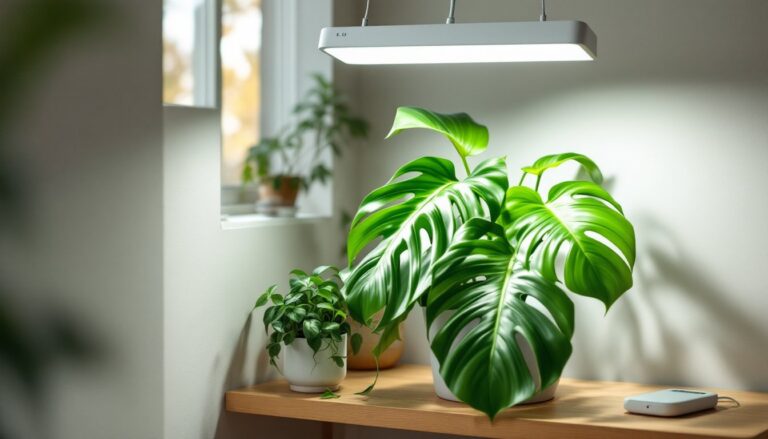
For beginner-friendly species like snake plants, philodendrons, or dracaenas, a basic 20-watt LED panel suspended 12–18 inches above the canopy works well. Those cultivating lush tropical varieties with higher light demands, monstera, bird of paradise, or croton, should opt for 40-watt+ panels or multiple units.
Fluorescent and CFL Options
Fluorescent tubes, especially T5 high-output (HO) fixtures, remain a solid budget choice. They’re widely available at big-box stores, run cooler than incandescents, and cover larger areas than single LED panels. A four-foot, two-tube T5 fixture costs around $40–$80 and works well for seed starting, propagation trays, or low-light plants.
The catch: fluorescent bulbs lose intensity after 10,000–20,000 hours, and they’re less energy-efficient than LEDs. They also require closer placement, 6–12 inches from foliage, because they don’t deliver the same concentrated output.
Compact fluorescent lamps (CFLs) fit standard sockets, making them convenient for desk lamps or clamp fixtures. A 23-watt CFL (100-watt equivalent) in the 5000–6500K color temperature range provides decent supplemental light for a single plant. They’re fine for maintaining green-leafed varieties in moderately lit rooms but won’t support vigorous growth on their own.
Skip incandescent and halogen bulbs entirely, they generate too much heat and deliver poor spectrum efficiency.
How to Position and Use Grow Lights Effectively
Distance and duration determine whether your setup works or fries your plants. Too close, and you’ll get leaf burn or bleaching: too far, and plants still stretch.
Start with 12–24 inches between the light and the top of the plant canopy, adjusting based on plant response and light intensity. High-output LEDs often need 18–24 inches of clearance: lower-wattage panels and fluorescents can sit closer. Watch for signs: if leaves curl, bleach, or develop brown edges, raise the light. If stems elongate and new growth looks pale, lower it.
Photoperiod consistency matters more than intensity for most houseplants. Use a plug-in timer, the kind with mechanical pins or a digital interface, to automate a schedule. Foliage plants generally want 14–16 hours daily. Flowering plants often need specific day-length triggers: research your species. Don’t leave lights on 24/7, plants need a dark period to complete respiration cycles.
Reflective surfaces amplify efficiency. White walls, aluminum foil, or purpose-made reflective film (like Mylar) bounce stray light back onto plants. In a grow tent or dedicated shelf setup, this can increase effective light by 20–30%.
Heat management is less critical with LEDs but still relevant. Even cool-running fixtures generate some warmth: ensure adequate airflow if you’re growing in an enclosed cabinet or tent. A small clip-on fan prevents stagnant air and reduces fungal issues.
Many curated lighting systems now incorporate adjustable height mechanisms, which simplify maintenance as plants grow. If you’re DIY-rigging a setup, use chain links or adjustable cord locks to change clearance without rewiring.
Best Practices for Different Plant Types
Light requirements vary widely. Low-light plants, pothos, snake plants, ZZ plants, cast iron plant, tolerate as little as 50–100 PPFD and 10–12 hours daily. A basic LED panel or T5 fixture provides enough supplemental light to keep them healthy in dim rooms.
Medium-light plants include most common houseplants: philodendrons, monsteras, spider plants, most ferns, and many palms. They need 100–200 PPFD and 12–14 hours of light. Position a 20–40 watt LED panel 12–18 inches above the canopy. These species often show the most dramatic improvement under grow lights, transitioning from survival mode to active growth.
High-light plants, succulents, cacti, citrus, herbs, and many flowering species, demand 200–400+ PPFD and 14–16 hours daily. You’ll need stronger fixtures (40+ watts for LEDs) positioned closer, or multiple panels to cover the area. For example, broad-leafed tropicals that evolved in bright, open canopies struggle without intense light: skimping here results in weak growth and poor coloration.
Seedlings and propagation benefit from 16–18 hours of moderate light (150–250 PPFD) positioned close, 4–6 inches for fluorescents, 12 inches for LEDs, to prevent stretching. As discussed by experts at The Spruce, maintaining consistent conditions during early growth stages sets up healthier mature plants.
Seasonal adjustments help mimic natural cycles. Some growers reduce light duration by an hour or two in winter to give plants a rest period, though this isn’t required for most foliage species. If you’re cultivating flowering plants, research their specific photoperiod needs, some require short days to initiate blooms.
Safety note: Keep lights away from flammable materials. Don’t drape fabric over fixtures or block ventilation slots. Use fixtures rated for damp environments if you’re growing in humid spaces like bathrooms. Wear eye protection if working near high-intensity lights for extended periods: prolonged exposure to bright LEDs can cause discomfort.
Conclusion
Grow lights aren’t a luxury for serious growers, they’re a practical tool for anyone whose living space doesn’t align with their plant ambitions. Choose LEDs for efficiency and longevity, fluorescents for budget-friendly coverage, and match intensity to your plant’s native habitat. Position lights correctly, automate the schedule, and adjust as plants respond. With the right setup, there’s no reason a basement apartment can’t support a thriving jungle.